July 17, 2011

Sebald's Last Interview


Here is the last interview by W.G. Sebald, before he died in a car crash at the age of 57. He was author of Vertigo, The Emigrants, The Rings of Saturn, and Austerlitz. All four books were published in the last decade of his life.

I liked his comments about writers and walking.

May 29, 2011

SQUEEEEEE!


Catherynne M. Valente is in Madison for WisCon, and I got to hear her read yesterday afternoon (from Fairyland)! In person, she's taller and quite a bit more attractive than I'd imagined, with long witchy hair and smouldering eyes. She's a great reader, and had the audience in stitches. Fairyland is doing extremely well - it's on the NY Times best seller list at the moment. I started reading it aloud to my daughter last night, and she's loving it.

May 8, 2011

Churches on Fire


I was disheartened to read this morning that a mob set a church on fire in Cairo. This is the latest in a series of violent inter-religious incidents that began on New Year's Day with the bombing of a church in Alexandria, in which twenty-three people died. I worry that the loosening of the political strictures has also freed people to express long-repressed emotions about the "other side." Christians form a substantial, prominent minority in Egypt (10-15%). Their religious practices and religious language (Coptic) are deeply connected to the ancient pharaonic religion.

Though many Egyptians, Muslim and Christian, are viscerally antagonistic toward each other, there are some outstanding exceptions. My wife and I spent three wonderful years working with Mennonite Central Committee in Beni Suef, where we were seconded to the Orthodox Church. Our supervisor, Father Youssef Andrawas, was one of the most saintly people I've encountered, with a passion for creating dialogue between Muslims and Christians. You can read a first-person account of his life and ministry, as well as a bit about our work, in this issue of A Common Place magazine (PDF file).

Beautifully, Christians met in their burned-out church on Sunday to celebrate mass (both images are from Storyful):

May 1, 2011

The Girl Who Circumnavigated Fairyland


Catherynne M. Valente's latest novel, The Girl Who Circumnavigated Fairyland in a Ship of Her Own Making (which started out as a novel mentioned in Palimpsest) is available as a free download till May 2 from here. This is actually the work that first got me interested in Valente, when she was putting it out chapter by chapter on her website.

April 14, 2011

Bad People


BAD PEOPLE
Robert Bly

A man told me once that all the bad people
Were needed. Maybe not all, but your fingernails
You need; they are really claws, and we know
Claws. The sharks - what about them?
They make other fish swim faster. The hard-faced men
In black coats who chase you for hours
In dreams - that's the only way to get you
To the shore. Sometimes those hard women
Who abandon you get you to say, "You."
A lazy part of us is like a tumbleweed.
It doesn't move on its own. It takes sometimes
A lot of Depression to get tumbleweeds moving.
Then they blow across three or four States.
This man told me that things work together.
Bad handwriting sometimes leads to new ideas;
And a careless God - who refuses to let you
Eat from the Tree of Knowledge - can lead
To books, and eventually to us. We write
Poems with lies in them, but they help a little.

March 27, 2011

Ishi and Le Guin


Wired magazine has an article about Ishi, the last of the Yahi tribe of American Indians, who died on March 25, 1916. He emerged from the wilderness in 1911, and was offered a place to stay at San Francisco's museum of anthropology. The anthropologists who took him in were T. T. Waterman and Alfred L. Kroeber. Kroeber's wife, Theodora Kroeber, later wrote Ishi in Two Worlds, based on Alfred's notes (she hadn't met Ishi).

Now, Alfred and Theodora Kroeber were, of course, the parents of Ursula Kroeber Le Guin. It is interesting to speculate on the impact the Kroebers' anthropological work had on her fiction. Always Coming Home and "Buffalo Gals Won't You Come Home Tonight" certainly draw heavily on American Indian culture. "Ishi" actually means "man" in the Yana language - he refused to reveal his true name. The notion of secret, powerful "true names" is, of course, central to the Earthsea books. Ged, as described in her novels, might have looked something like Ishi. And the trope of the solitary carrier of information is present in works such as The Tombs of Atuan, "The Stars Below," and The Dispossessed.

March 20, 2011

Roald Dahl


My wife got me Storyteller: The Authorized Biography of Roald Dahl for my birthday. I've been a huge fan of Dahl's since I was about five. I love Charlie and the Chocolate Factory, James and the Giant Peach, and, especially, the stories.

Here are some interesting tidbits:

It turns out that much of the received lore - that his Gloster Gladiator was shot down over Libya, that he wrote Charlie to pay for Patricia Neal's treatment after a stroke, that he had invented gremlins - was either fabricated or embellished.

The original Charlie was black, possibly based on Dahl's servant Mdisho in Tanzania. The Oompa Loompas were originally "African Pygmies," but had to be made blond after an outcry from the NAACP. (Irrelevant aside: my favorite cat, Mihwi, was eaten by pygmies in Burundi.)

After his first book of stories - the excellent Over to You - he struggled for years. His first novel, Sometime Never, was a complete failure, and is now out of print. No one would take his second, Fifty Thousand Frogskins. This was actually the most interesting information in the book to me. I have always felt that the four stories grouped under the title "Claud's Dog," as well as "Parson's Pleasure," in which Claud appears, were his best work. I'd even commented to my wife at one point that if he'd turned those into a book, it would have been an amazing work. Now, apparently the Claud stories were salvaged from Fifty Thousand Frogskins after it failed to find a publisher. So this means that the book I crave is actually out there! Will someone please, please publish it! Incidentally, Claud, and the father from Danny, the Champion of the World, were based on a neighbor, Claud Taylor, who was "a storyteller and a bit of a rogue," and was one of Dahl's favored companions.

Dahl was impossibly irascible. The book is worth reading just for some of his nasty exchanges with his publishers.

He spied for Britain, filing reports on politicians and socialites in Washington, D.C.

Ursula Le Guin disliked Charlie because it made her "usually amiable" daughter "quite nasty." I have noticed no such effect on my daughter.

As we're on the topic of Charlie, I have to end this post with my favorite lines:

"And cannibals crouching 'round the pot,
Stirring away at something hot.
(It smells so good, what can it be?
Good gracious, it's Penelope.)"

March 9, 2011

The Caresses


The Caresses, by Belgian surrealist Fernand Khnopff. One of my favorite paintings. Click on the image for a full-screen version.

March 7, 2011

The Book of Flying on the Radio


The Book of Flying was the "Book of the Week" on the sci-fi radio show DeFlip Side (hosted by Destinies - The Voice of Science Fiction):

"The Book of Flying is best characterized as an adult fairy tale, and as such, it’s poignant and moving and (dare I say it?) enchanting. If you’re a fan of fanciful prose, and feel (as I do) that beautiful writing can be an end unto itself, then The Book of Flying is the book for you."

February 18, 2011

Awful Poetry


Some years ago, my friend Lionel Thompson turned me on to The Stuffed Owl, a wonderful collection of terrible writing, which has been reissued by New York Review Books. Here are some gems:

“Dust to dust, and ashes to ashes:
Into the tomb the Great Queen dashes.”

—an anonymous Indian poet

“So we leave her,
So we leave her,
Far from where her swarthy kinsfolk roam;
In the Scarlet Fever,
Scarlet Fever,
Scarlet Fever Convalescent Home.”

—Anonymous

“She sat with her guitar on her knee,
But she was not singing a note,
For someone had drawn (ah, who could it be?)
A knife across her throat.”

—Lord Lytton

“Holy Moses! Have a look!
Flesh decayed in every nook!
Some rare bits of brain lie here,
Mortal loads of beef and beer,
Some of whom are turned to dust,
Every one bids lost to lust;
Royal flesh so tinged with 'blue'
Undergoes the same as you.”

—Amanda McKittrick Ross (Possibly the worst writer who ever lived. The Inklings used to hold competitions to see who could read her poetry for the longest without laughing.)

“Of composts shall the Muse disdain to sing?
Then, planter, wouldst thou double thy estate,
Never, ah! Never, be ashamed to tread
Thy dung-heaps . . .”

—James Grainger

And here's my own addition, from A.S. Byatt's otherwise fabulous Possession:

“Others in a heavy Vase
Raise darkly scented Wine -
This warm and squirted White
In solid Pot - was mine . . .”

February 9, 2011

Hyper Hundred!


The Book on Fire has been chosen as one of the hundred best sci-fi and fantasy novels of 2010 at the influential SF Crowsnest! I'm delighted.

February 8, 2011

Carved Books


Julia Fields makes these extraordinary objects by cutting through books. See more here. Some are available for purchase here.

February 3, 2011

Lafcadio Hearn


A reader recently queried me about the ghost story I purloined from Lafcadio Hearn and used in The Book of Flying. I'd forgotten which one it was, so had to order the book through inter-library loan. It was in an essay called "The Chief City of the Province of the Gods." Here it is:

"In Nakabaramachi there is an ameya, or little shop in which midzu-ame is sold,―the amber-tinted syrup, made of malt, which is given to children when milk cannot be obtained for them. Every night at a late hour there came to that shop a very pale woman, all in white, to buy one rin worth of midzu-ame. The ame-seller wondered that she was so thin and pale, and often questioned her kindly; but she answered nothing. At last one night he followed her, out of curiosity. She went to the cemetery; and he became afraid and returned.

"The next night the woman came again, but bought no midzu-ame, and only beckoned to the man to go with her. He followed her, with friends, into the cemetery. She walked to a certain tomb, and there disappeared; and they heard, under the ground, the crying of a child. Opening the tomb, they saw within it the corpse of the woman who nightly visited the ameya, with a living infant, laughing to see the lantern light, and beside the infant a little cup of midzu-ame. For the mother had been prematurely buried; the child was born in the tomb, and the ghost of the mother had thus provided for it,―love being stronger than death.
"

Hearn had an interesting life. His father was Irish, his mother Greek. He moved to the States at nineteen, and became a writer. He was apparently pretty odd-looking. He'd lost an eye in an accident, and the other was enlarged. He was also very short. Perhaps due to his "monstrous" appearance, he was fascinated by the macabre, reporting on crime, and interested in ghosts. He married (illegally at the time) a black woman, was forced from his position as a journalist when that was discovered, and then divorced her. He wrote about New Orleans and Martinique, but found his calling in Japan, where he married a Japanese woman, became a teacher, and settled down. His writings on Japan are just wonderful. They are in the public domain, and may be downloaded here.

UPDATE

After I posted this, another reader wondered if Shel Silverstein's lion was named after Hearne. I'm not sure if he was directly, but Hearne was apparently the first person to bear the name, which was taken from Lefkada, the Greek island where he was born.

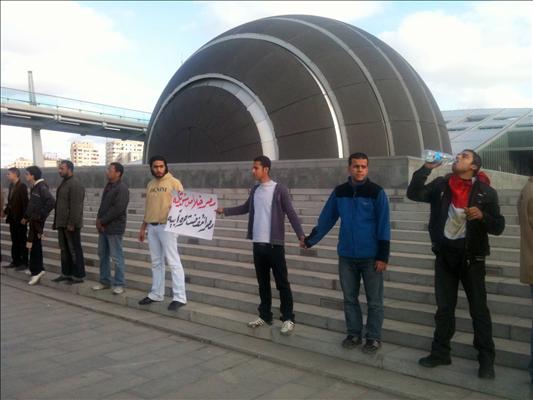
Protecting the Bibliotheca Alexandrina


People have formed a human chain around the Bibliotheca Alexandrina (the new Library of Alexandria) to protect it from looters. More pictures here.

February 1, 2011

Egypt on Fire


via Reuters

As the momentous events continue to unfold in Egypt, I have been struck by the basically decent responses of most Egyptians. After days of trying to call, we finally managed to contact friends in Beni Suef, both Muslim and Christian. They have spent all their money on food and are barricaded in their houses. The young men of each block gather every morning to patrol their neighborhood, turning looters over to the army. I was heartened to read that citizens, on their own initiative, organized to protect the Egyptian Museum.

On the Bibliotheca Alexandrina website, director Ismail Serageldin writes:

"The young people organized themselves into groups that directed traffic, protected neighborhoods and guarded public buildings of value such as the Egyptian Museum and the Library of Alexandria. They are collaborating with the army. This makeshift arrangement is in place until full public order returns.

"The library is safe thanks to Egypt’s youth, whether they be the staff of the Library or the representatives of the demonstrators, who are joining us in guarding the building from potential vandals and looters."

Libraries in Egypt, it seems, are always in danger. One could argue that cutting off the net, as Mubarak has done, is a modern form of book-burning.

Of course, I can't help but note that the scenes at the end of The Book on Fire, with Alexandria burning and running battles in the streets, seem to be coming to life. Those scenes were inspired partly by the events I witnessed in 2006, when Coptic Christians were stabbed in several churches and inter-religious tensions were running high. So far, in the current events, the religious element has been somewhat submerged under the general euphoria, but it will certainly play a huge role in the coming months.

I hope that the outcome of the present struggle is peaceful and results in greater freedom and stability, and that the libraries of Egypt, in whatever form, emerge from the fires with new wings . . .

Catherynne Valente on Persephone


On Catherynne M. Valente's Livejournal blog, she has a lovely post on her obsession with and affinity for Persephone (Proserpine/Proserpina). As always, I'm struck by Valente's extraordinarily supple prose, and her deep intelligence. The Persephone myth has always resonated for me as well, and (skewed and co-opted), informs The Book on Fire. The picture above is one of my favorites: Dante Gabriel Rossetti's Proserpine.

January 15, 2011

Walton Ford


Bula Matari


Chungado


Over at Biblioklept (a marvelous site), I discovered the work of Walton Ford. Extraordinary stuff!

January 9, 2011

Writers and Driving


Martin Amis, in The Information, wrote: “Poets don't drive. Never trust a poet who can drive. Never trust a poet at the wheel. If he can drive, distrust the poems . . .” When I first read that, I thought it was just Amis being hyperbolically amusing. But I recently discovered (on her marvelous new blog) that Ursula Le Guin doesn’t drive. Now, I also don’t drive, and neither does my wife. Part of my aversion to cars arises from a conscious decision to use less of the world’s resources, but there is also an innate dislike of the car as object. I love traveling by bicycle and train, but zipping around in a stinky little metal box is yucky. I knew that Nabokov never learned to drive, though he sometimes wrote in the car (that's him up there, with his index cards). His wife Vera drove him on his butterfly-catching expeditions. C. S. Lewis didn't drive. And Ray Bradbury has famously never learned to drive. Of course, there are also wonderful writers who celebrated driving – On the Road and the opening scene of All the King’s Men come to mind – but perhaps there is something behind Amis’s comment. It would be fun to compile a list of writers who don’t drive, and then see to what extent one can trust their poems.

December 12, 2010

Cavell, Companionship, and Christian Theology


My friend Peter Dula’s book Cavell, Companionship, and Christian Theology has just been published by Oxford. Pete, who teaches religion at Eastern Mennonite University, is one of the smartest and best-read people I’ve met. His reading seems to have no borders: he is versed in philosophy, theology, poetry, and fiction, as well as environmental and bicycling texts. He’s one of the few people I know who can put Tolkien, Tolstoy, and Wittgenstein into the same sentence.

I got to know Pete while serving as a peace worker with Mennonite Central Committee in Burundi. He later went to Iraq, as MCC’s peace worker there (taking over from my brother, incidentally). He subsequently published a number of articles in various Christian periodicals. One, "The War in Iraq: How Catholic Conservatives Got It Wrong," refuted claims that the Iraq war was just, and generated a heated online debate.

Pete was drawn to Stanley Cavell, who is regarded as something of an oddball in philosophical circles, partly because of his interest in literature: Cavell has a deep reverence for Shakespeare, Austen, and Emerson, among other writers. Cavell, Companionship, and Christian Theology is the first text to bring Cavell’s ideas into the realm of theology. Pete’s book is deeply literary, discussing, among other writers, W. G. Sebald (and I believe I was the first person to suggest Pete read Sebald – after reading about him in a James Wood volume Pete had sent me!) and Nabokov (Speak, Memory), and poets from Auden to Coleridge to Heaney. The book is scintillatingly well-written, in an accessible style that manages to be both conversational and densely literary. My favorite line: “The good critic is the one most adept at giving reasons for Tolstoy’s superiority over Dostoevsky.” I suggest you buy the book.